
Author: CMAA Australia


By: Michael McQueen
HR is becoming less about administering employment and more about designing the conditions in which humans and machines work together well.

By: Adriana Wales
The good news is that being emotionally connected to your child isn’t about always being calm, perfectly patient or making kids happy all the time.

Do you ever feel the weight of life? Sometimes, despite our best intentions to rest and maintain a good work-life balance, the day-to-day can feel heavy.

How to really check in with your child.

By: Jeshua McPhail
As someone who was training to become a champion fighter, I thought I was tough. But it’s not until something you deeply care about is nearly taken from you that you realise how easily you can break.

By: Hope Media
New research quantifies community radio’s economic and cultural impact – but the deeper value goes beyond numbers.

By: Adriana Wales
There’s an art to building new friendships as a new mum, when the fog of endless feeding, changing, settling can dull your usual social skills.

By: Tony Davenport
A third of young people are now using an AI companion, according to new research.

By: Ken Robinson
Have you ever noticed how quickly your mood can change? You can be enjoying a wonderful day when, almost without warning, a single thought enters your mind. It might be about your finances, your health, your family or something happening at work.

By: Andrew Marsh
Australians are being encouraged to join millions of people around the world in spending time in the Bible every day this November as part of Global Bible Month.

By: Adriana Wales
Who will care for your kids if the worst happens? Discover how to choose a legal guardian and protect your children’s future with confidence.

By: Laura Bennett
The four-time World Champion cyclist, surfer and adventurer lost 95 per cent of his vision at the age of five, and he faces every challenge with one simple question.

By: International Justice Mission (IJM)
The Internet is always on. The online world is part of everyday life for our kids. It’s where they learn, play, connect with friends and explore their interests. But the same features that make those experiences possible can also expose children to people who want to exploit their trust.

By: Mariska Meldrum
A few months ago, 12-year-old Jonathan had no water to drink three days a week. In his remote village in Simanjiro, Tanzania, fetching water meant enduring a dangerous four-hour trek – often encountering wild animals along the way.

You’re doing the same thing everyday… And that’s good.

Rest can look different through the various stages of life, but is it something we can ever afford not to do?

By: Justin Rouillon
Loneliness and social isolation are serious public health threats, so Shed Happens started a men’s group in a truck yard.
Read more: Shed Happens: Building Connections And Support For Men
Shed Happens is an organisation that has been helping Aussie men find connection, encouragement and friendship for almost 25 years. Founded by the late Ian ‘Watto’ Watson, Shed Happens was built on Ian’s motto that he’d “never seen a bloke go backwards with encouragement”.
Vern Wilson- a committee member of Shed Happens- explains how this innovative program moves beyond conventional community group models by focusing on heartfelt conversations.
“ If you give men a safe environment, they generally will open up and talk more freely about things that they’re going through,” Vern said.
“ Instead of being like a woodwork shed, we’re a shed that actually interviews people. The topics cover the good, the bad, the sad and the ugly, and we have men involved across every age group.”
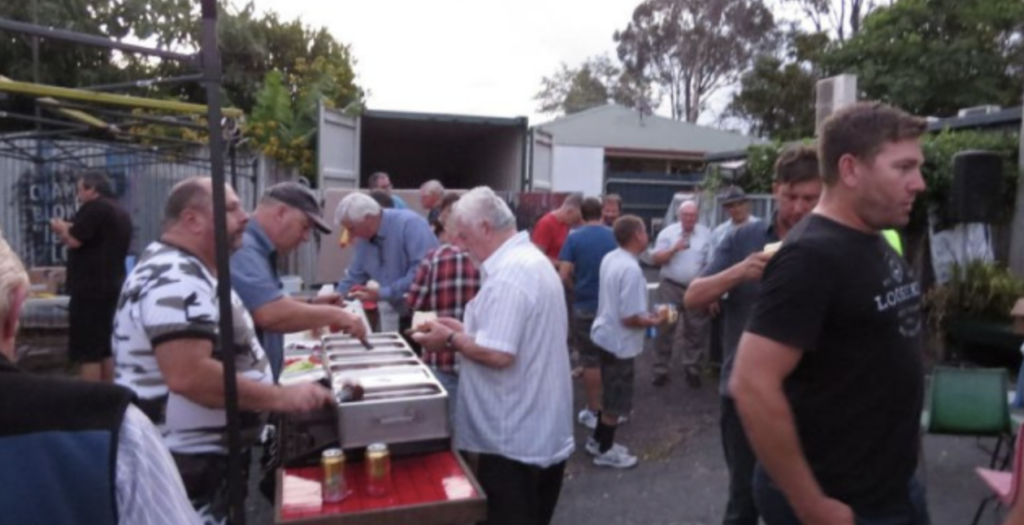
Shed Happens in full swing at Watto’s truck yard in Murrumba Downs. Image credit: Supplied
The initial idea for the ministry came after the loss of one of Watto’s good mates Greg Polinski to suicide in the late nineties.
Before his passing, Greg didn’t know how to share what he was going through with those around him.
“He sadly took his life because we couldn’t talk – we didn’t know how. So that has been a major driver behind Shed Happens. We want to help men tell their story in a supportive environment without judgement. We can’t be isolated from each other – connection touches people’s hearts.”
Vern shared how Watto noticed how men would open open up to him in the cab of a truck, while receiving lessons and training.
“Watto had a truck driver training business, and he would give lessons to men getting their truck licenses, and he found the one-on-one time was just so incredible with these guys.
“They would sit and talk about issues in their life that often you’d never get to hear about. And he thought, why couldn’t we bring men together with a format that actually allows a safe place for these men to come along and talk.”
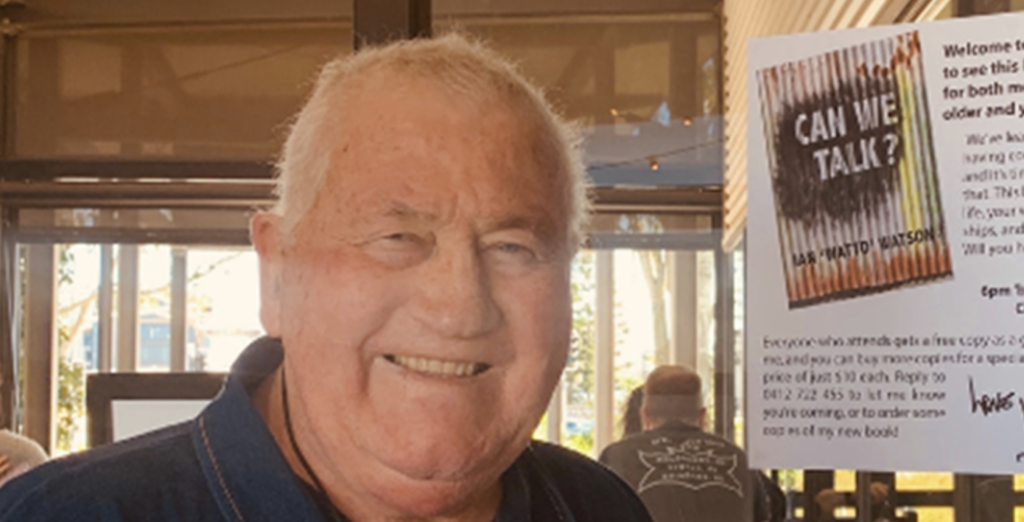
Founder of Shed Happens Ian ‘Watto’ Watson was also an author of four books. Image credit: Justin Rouillon
By offering a welcoming environment, Shed Happens enables men to discuss issues they face, including topics like relationships, health, and personal struggles.
Originally starting in a church setting, Watto moved the gathering to his Murrumba Downs truck yard, to help men who may have otherwise found it difficult to set foot inside a church.
“ Absolutely any bloke can come along irrespective of their background, their culture, whether they go to church or not,” said Vern. “The aim of these meetings is to draw people in that are needing a bit of help and needing somewhere to go for friendship – it’s all about connecting.”
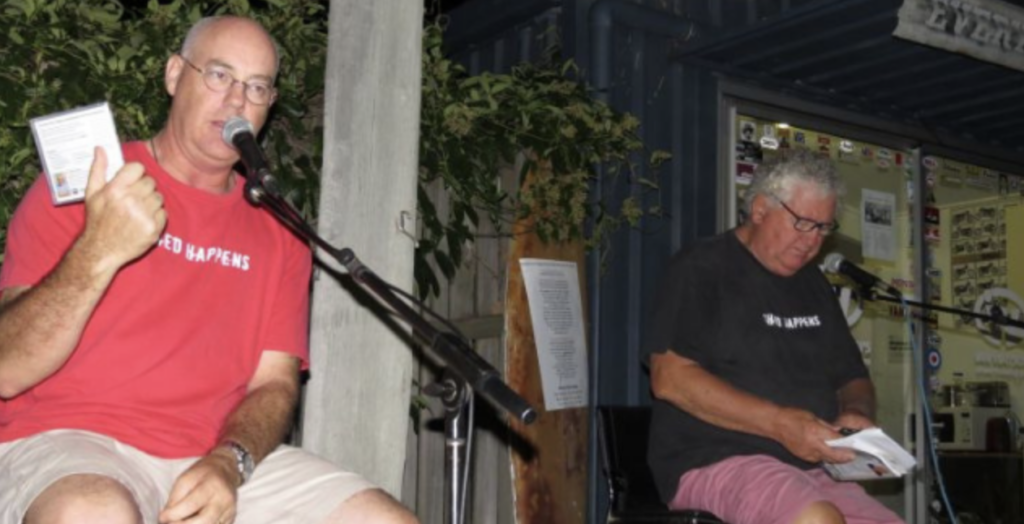
Watto (right) leads a Shed Happens gathering. Image credit: Supplied
Shed Happens has now spread all over Australia. For those looking at ways to support and encourage men, it’s an easy gathering to get up and running.
“ It doesn’t need to run in a shed. It doesn’t need to run under a church covering. It just needs a few good guys that say, ‘Hey, I’ve been through the battle of life. I’d like to support somebody else in the journey.’
“ A lot of our guys run sheds out of a coffee shop; they just ask if they can sit in the back corner with ten or twelve people around a table and just do a morning tea.”
Find out more about Shed Happens.
If anything in this story has affected you, contact Lifeline or Beyond Blue.

Have you ever hit a point where even resting feels exhausting? These Bible verses are an invitation to pause, breathe and actually stop.

By: Richelle Wenhem
Where there is great love, grief is often found close by. Grief is simply part of the cost of caring.
Read more: The Untold Story Of Grief: Our Friend
The doctor’s office was unusually quiet. It was a cool Monday morning. The fluorescent lights hummed softly overhead as I sat alone, waiting for answers about my unborn daughter.
In a matter of moments, everything I thought I knew about the future changed.
The words came gently enough. Down syndrome. Developmental concerns. Possible complications ahead.
Yet grief arrived like a truck travelling at full speed.
Not because there was anything wrong with my daughter.
Not because she was somehow less valuable, less precious, or less loved.
Quite the opposite.
The grief came because I suddenly realised I was letting go of the child I thought I was going to have. The future I had imagined. The expectations, dreams, and assumptions I didn’t even realise I was carrying.
All those expectations and ideals flew out the window like a sparrow on a hot summer’s day, gone in an instant.
I didn’t know it then, but this is one of the most common and human experiences for parents and carers. Before we can embrace a new reality, we often have to let go of the one we imagined.
So, when I sat down to write this for National Carers Week, I first thought about writing why I believe people living with disability are blessed, because they are. Then I thought about writing how churches can better support carers and parents of children with disability, because there’s always room for more understanding, prayer and practical support.
But every time I started writing, my thoughts returned to something else.
Grief.
I know, it sounds like a strange topic for National Carers Week.
Yet after eight years of caring, I’ve come to realise that grief may be one of the healthiest friends a carer can have.
The Cost Of Loving Deeply
In the first few years of my daughter’s life, I would often feel completely fine.

We did the appointments. The therapy sessions. The home programs. The specialist reviews. Then suddenly grief would rise within me like a rip current pulling me out to sea.
A difficult report. Another missed milestone. A new NDIS battle. After a few days, the waters would settle again and I’d be okay.
At first, I thought something was wrong with me. Why couldn’t I just move on? Why did grief keep returning?
But over time I realised grief wasn’t coming back because I was weak in my faith. It was returning because I loved deeply.
People often say to carers: “I don’t know how you do it.”
Yet the answer is actually very simple.
Love.
Whether you’re supporting a child through countless therapies and operations. Whether you’re helping someone who struggles to speak, eat, walk, see or remember. You do it because you love them.
Love compels us. Love shows up.
The Bible reminds us: “Above all, love each other deeply, because love covers over a multitude of sins.” 1 Peter 4:8
And where there is great love, grief is often found nearby.
Most people think grief arrives after a funeral.
But carers know differently. Grief often lives quietly alongside us. Because grief is simply part of the cost of caring.
The Companion I Didn’t Expect: Grief My Friend
Then a grief counsellor shared something that completely changed how I view grief. Instead of viewing grief as an annoyance that we constantly push away, what if we allowed ourselves to sit with it?
What if we treated grief like an old friend?
At first, I hated the idea.
Who wants grief as a friend?
Surely the goal is to get rid of it. But the more I reflected on those words, the more I realised how much energy I was spending fighting grief.
Every time it appeared, I tried to distract myself, stay positive or move on as quickly as possible. Yet grief would always come back.
Eventually, I stopped seeing grief as an enemy and started seeing it as a messenger. Not a permanent house guest, but someone worth listening to. Because grief often points us towards the places where healing is needed.
As carers, I think this is one of the greatest lessons God can teach us.
We need to spend time with our grief. Not as victims. Not to stay stuck. But to acknowledge what is real. Sometimes that may look like sitting quietly overlooking the beach.
Sometimes it could be journalling for fifteen minutes.
Sometimes it was simply letting grief in, while I prayed.
The Psalms are full of this kind of honesty.
David wrote: “The Lord is close to the brokenhearted and saves those who are crushed in spirit.” Psalm 34:18
God never asks us to pretend we are okay. He simply asks us to bring our hearts to Him.
The Grief Cycle Carers Know Well
If you are a carer, chances are grief doesn’t visit once. It comes in waves.
For me, it circles back again and again.
And even as I write this, we’re preparing for our daughter’s fifth eye operation.
However, this time, something has changed. Less than a year ago, I realised I had become stuck in survival mode. I remember telling a friend:
“I just can’t relax. I’m always waiting for the next phone call. The next piece of bad news.”
Living like that was stealing my joy.
But as I learned to sit with grief my friend, instead of fighting it, I found myself trusting Jesus more deeply.
Again and again, I handed my daughter back to Him.
Again and again, I admitted I wasn’t in control.
Again and again, I remembered that He loved her even more than I do.
The Peace I Never Expected
And recently, the thing I had been dreading finally happened.
Another eye surgery. But this time my response surprised me. The circumstances hadn’t changed. The risks hadn’t changed.
Yet my heart had.

For the first time, I truly experienced what Scripture describes as:
“The peace of God, which transcends all understanding, will guard your hearts and your minds in Christ Jesus.” Philippians 4:7
The peace didn’t come because everything was fixed. The peace came because I knew I didn’t have to carry everything myself.
God had not asked me to control the outcome. He had simply called me to walk faithfully beside my daughter through it.
So this National Carers Week, I want every carer to know this:
Your grief is real. It matters. It deserves attention.
But it is not something to fear.
It is not a problem to solve. It is not evidence of weak faith. It is not something to be ashamed of.
Sometimes, it is simply love revealing how deeply we care.
Like Job in the bible, we may find ourselves walking through seasons we would never have chosen. Yet God never abandons us in those places. Instead, He meets us there.
And when we allow ourselves to walk honestly through grief with Him, He can lead us somewhere unexpected.
Peace.
“You will keep in perfect peace those whose minds are steadfast, because they trust in You.” Isaiah 26:3
My prayer this National Carers Week is not that your caring journey becomes easier.
My prayer is that whatever grief you carry, you will discover the peace of Christ that surpasses all understanding. So that you can continue caring for your loved ones. One day at a time.
So, what next? This National Carers Week, my invitation is simple: make space for what you’re carrying. If you’re a carer, sit with your grief, pray through it, and allow God to meet you in it. You don’t have to carry it alone.
And for those supporting carers, let’s do more than say “thank you.” Take time to really see them. Ask how they’re coping. Listen without trying to fix. Pray without offering easy answers. Sometimes the greatest gift we can give a carer is the space to be honest about both their love and their grief.
Together, may we create communities where carers feel seen, supported, and reminded that they are never walking this journey alone.
Need Support? These Resources Can Help
Carer Gateway
Australia’s national support service for carers, offering free counselling, coaching, peer support groups, respite assistance, and practical resources. Call 1800 422 737 or visit carergateway.gov.au.
Carers Australia
Provides advocacy, information, and links to support services for carers across Australia, including guidance on navigating caring responsibilities and available assistance. carersaustralia.com.au
Your Local Church Community
Don’t underestimate the power of reaching out. A pastor, prayer group, trusted friend, or church family can provide encouragement, practical support, and a safe place to share honestly.
Luke14
Luke14 Australia exists to help churches become places where people with disability, their families, and carers belong and flourish. They offer practical resources, training, and encouragement for churches wanting to better support disability inclusion. Visit luke14.org.au.
Professional Christian Counselling
If grief feels overwhelming, consider speaking with a Christian counsellor through your local church network or a trusted Christian counselling service. Seeking support is a sign of wisdom, not weakness. Hopechristiancounselling.com.au
Lifeline Australia
If you’re feeling distressed and need immediate support, call 13 11 14 anytime, 24 hours a day. Carer Gateway also refers carers to crisis support services when needed.

By: Michael McQueen
How do we harness the power of technology, without allowing it to reshape young brains and change the way we learn?

By: Adriana Wales
Tasked with raising a generation of boy who will have to navigate a complex world of diversity and rapid change, here’s how to teach them to be great humans.

By: Mark McCrindle
AI has moved from the realm of science fiction into the everyday of Australian life. What was an emerging technology just a few years ago is now embedded in how we search, write, plan, shop and work.

Rest is discipline. That’s probably not what we think of when we think of rest. Still, it requires discipline, boundaries, and clarity about priorities.

By: Ben McEachen
The early church’s commitment to generosity can feel confronting in a culture that encourages people to build security through possessions and finances.

By: Helping Hands TV
The simple gift of being truly present with someone matters more than you think.

By: Tony Davenport
A third of young people are now using an AI companion, according to new research.

By: Michelle Nortje
Burnout doesn’t usually arrive as a single bad week. It builds — a slow erosion of energy, motivation and meaning that can leave even highly capable, high-performing people feeling like a shell of themselves at work.

By: Adriana Wales
Try these simple tips to stretch the household budget and minimise food wastage at your place.

By: Michael McQueen
For generations, the career advice seemed straightforward: get educated, learn to think, and try to make a living with your brain rather than your back.

By: Beth Rivers
How emoji trends have shifted from pandemic-era reactions to everyday laughter, and why Australians are still embracing these tiny digital expressions.

Have you ever wondered if God actually cares about your Monday morning inbox?

By: Sabrina Peters
There’s a quiet lie many of us believe: happiness means not having to do anything hard.


By: Adriana Wales
It’s not Insta-worthy styling and curated birthday themes, but rather the feeling of being the main character who’s visibly, publicly acknowledged.

By: Annonymous
Every relationship consists of two people, but the hard truth was the most consistent factor in my failed relationship, was me.

By: Helping Hands TV
Forgiveness isn’t about excusing wrongdoing or forgetting pain – it’s about freeing ourselves to move forward.

By: YiQin Houston
Many of life’s heaviest burdens are the ones we can’t see, as the constant cycle of remembering, planning, organising and caring quietly shapes each day.

By: Brian Harris
While we live in an increasingly competitive, uncaring world, compassion and care are often found in unexpected places.

By: Audrey Waugh
One thing that’s made an enormous difference in my life: learning to listen to God.

By: Monica Jacob – The Centre for Effective Living
There’s something about the shift in season that makes starting fresh feel possible again. What if we applied that same instinct to our minds?


By: Adriana Wales
Real financial literacy is about helping kids develop the skills to make good money choices throughout life.


By: Alex Cook
Five considerations to help calculate a real retirement number based on your actual life.


By: Madonna King
In a world proliferated by the use of AI, what do parents need to know to keep their children safe from the unspoken dangers?

What it means to give thanks in all circumstances


By: Brian Harris
Because perspective matters when it comes to success, opportunities and the difficulties of of life.

What Joseph’s story reveals to us, and how God speaks through His Word in places we would least expect.

By: Tosh Sturgess
Masculinity has had a pretty bad rap from the media recently, but good men add incredible value to their families, friends, colleagues, community and broader society.

By: International Justice Mission (IJM)
Online sexual exploitation is one of the fastest-growing forms of child exploitation, and it is not a distant problem.


By: Hope Media
New McCrindle research reveals Australian parents value updates about their child’s social and emotional wellbeing just as much as academic results.

By: Convoy of Hope
More than 90,000 people are impacted after flash flooding and a 5.2-magnitude seismic event struck communities in Nepal on August 26.

Why do people who do wrong seem to prosper while I struggle?

By: Ben McEachen
Ian Barnett’s level of preparation for being a grandparent was “absolutely nothing”.


By: Convoy of Hope
A 5.2 magnitude landslide, paired with flash flooding, has devastated communities in the region.


By: Laura Bennett
‘The Chosen in the Wild’ revealed the surprising impact The Chosen has had on its cast, leading to honest conversations about faith and life.


Or what happens to a voice artist if their voice is cloned and used without their permission?


By: Chris Jolly
Scripture Union NSW CEO Jim Wackett shares practical advice for understanding God’s Word and growing in faith.

Why two Christians can read the same Bible and disagree


By: Isabelle Colla
Australia’s Modern Slavery Act will be strengthened with a new criminal offence and civil penalties.


By: International Justice Mission (IJM)
His story is a testimony to his resilience, courage and the power of survivor-led advocacy.


Their purpose and how to use them


By: International Justice Mission (IJM)
International Justice Mission Warns of Growing Forced Scamming Crisis.


How do you know what’s real anymore?


By: Laura Bennett
Behind the spectacle of Nolan’s ancient world lies a story about faith, suffering and showing kindness to strangers

For many Australians right now, financial pressure is hard to ignore.

Between work, family and endless distractions, life can feel louder than ever.
